Thursday, January 21, 2016

When I die, bury me


One of six stories behind the 'In the Garden' interviews from the 2015-16 Summer Series of Talking Plants on ABC Radio National (copied from ABC RN homepage).

When I die, bury me

Friday 18 December 2015 10:39AM
Tim Entwisle
Trees can be a source of solace and stability in a sometimes hostile world. That's especially true in cemeteries, where our bodies can nourish the natural world after we die, providing an enduring sense of connection, writes Tim Entwisle, director of the Royal Botanic Gardens Victoria.
I often wonder why there aren't more trees in our cemeteries. I also wonder why our cemeteries aren't more attractive places to visit.
Recently I went to a cemetery in Newtown, in the heart of Sydney's inner west. I was meeting landscape designer Georgina Reid to find out why she chooses to spend every lunchtime there.
Yeah, I'd like to be food.
GEORGINA REID, LANDSCAPE DESIGNER.
While I was waiting for her, and within minutes of arriving at the Camperdown Memorial Rest Park, I was swooped by magpies. Two young goths dressed entirely in black were taking in the funereal air. Later, a mother gently dropped her daughter over a fence onto a gravestone. Locals walked their dogs, and a crew of volunteer gardeners bobbed around with their heads down and bums in the air. I didn't expect so much life in a cemetery.
Then again, this is an unusual burial ground. It was started in 1858 and closed 18 years later, overflowing with bodies and not the most pleasant of places to visit. The upside of this was plenty of nutrients for the newly planted trees. Those trees are still with us, and they are magnificent.
Reid edits the online magazine The Planthunter and she spoke to me of her daily walks through the cemetery, and her sense that the trees and the body-ridden earth are inexorably linked. 'I find it really peaceful and somewhere that I can breathe, and that's as much to do with the trees as the beautiful old gravestones', she said.  You can read more in her article,Cemeteries: Death and the Landscape.
This cemetery has stately oaks, Canary Island date palms and one giant Moreton Bay fig. It also has patches of remnant kangaroo grass, among which the weeders I saw presumably do all they can to encourage various local wildflowers.
Horticulture is now part of many progressive cemeteries. Not all, mind you. Reid mentioned some new cemeteries call themselves 'memorial parks', but in reality are nothing like a park. They are devoid of any vegetation other than turf and a rose or two (plastic or real). She prefers the genuine park-like feel of the Camperdown graveyard.
'It's a bit rough, it's not manicured in the slightest, that also appeals to me,' she said. It harks back to an earlier age when cemeteries were places of recreation as well as mourning. 'In the 19th century cemeteries were used as public parks, which I think is positive.'
In Melbourne, the Greater Metropolitan Cemeteries Trust looks after 17 cemeteries. They have publicly stated their intention to create places that people will choose visit more often—not only to visit the gravesites, but also to picnic, stroll or go to a cafe. For the trust, horticulture is as important as tombstones. Kew Cemetery (also known as Boroondara General Cemetery) near me in Melbourne is extremely proud of its trees, and you can do a walk to locate them all, plus the interesting graves.
There are plenty of more adventurous projects and project ideas out there about how to deal more efficiently with our bodies once we die, and how to make the connection between humans and the rest of the living world stronger.
There is the US Urban Death Project, where corpses would be placed in a 'giant tower' to decompose for about six weeks, after which they would be converted, more or less, to compost which would be either returned to families or 'spread in national parks'. I'm not sure that national parks need to spread compost, but we get the general idea.
News reports quoted research from the USA showing that it takes 90,000 tons of steel, nine million metres of hardwood and 1.6 million tons of concrete to bury the dead each year in that country alone. Meanwhile, cremation has come under fire for the amount of energy used to combust a body. 
One of the advertising slogans for the Urban Death Project, which is crowd-sourcing for funds, is 'eventually I'll be a lemon tree'. (The Australian male, in particular, notoriously contributes some of himself to a lemon tree every time he relieves himself in the backyard.) The project argues that it is more than simply a method for turning our no-longer-needed bodies into plant food, but a better way to understand our place in the natural world.
In Australia, Living Legacy, led by Warren Roberts, is a fledgling program to combine the ashes of the dead with living forests. This particular concept is likely to be more about a spiritual and intellectual connection with the living world than fertilising it, but it too is part of a change in our attitude towards the dead. 
So what about Reid's wishes for her final repose? On her daily visits to the cemetery in Newtown, I imagine she must have pondered what she wants to happen to her body when she dies. 'I'd like to be feeding one of these amazing trees: a lemon-scented gum or an angophora or even an oak,' she told me. 'Yeah, I'd like to be food.'
Trees in a cemetery, and trees that interfere (in the nicest way) with the plots, would seem to be a simple way to connect spent bodies with a world that continues beyond their life. We who are living can then enjoy those trees, and our cemeteries.

A gardening show with a twist. Talking Plants is a witty and at times provocative discussion show on all things botanical.

Monday, January 11, 2016

Plants fart to protect


Print: New Scientist no. 3055, 9 January 2016
On-line: 6 January 2016

Farting plants have a built-in stink bomb that deters predators

Farting plants have a built-in stink bomb that deters predators

“OH MY goodness! It smells like someone has broken wind.” So says Rabi Musah of the University at Albany in New York, who has discovered a previously unknown defence mechanism in plants: roots that actively release a nasty smell when they sense the touch of a potential threat.

Many plants are famed for their putrid smells, and it has been known for decades that unpleasant sulphurous odours are released when soil is disturbed around the roots of some plants – including members of the Mimosa genus. Until now, it has been assumed that these odours are released passively as a result of tissue damage, like when a bay leaf is crushed or onions are cut with a knife.

But Musah has found that the roots of some species actively release their foul smell. Her team made this discovery while growing seedlings of Mimosa pudica, known for its sensitive leaves that fold up when touched. They found that this plant’s roots are also touch-sensitive, releasing the odour when accosted (Plant Physiology, DOI: 10.1104/pp.15.01705).

The smell – a cocktail of sulphur compounds – seems to be released from tiny hair-like sacs less than half a millimetre long and dotted along the roots of the plants, which collapse after the odours are released.

Even a seedling just a few centimetres high can fill a room with a disgusting smell, says Musah. Seedlings grown in sterile conditions still produce the sulphuric scent, indicating that it is a product of the roots themselves rather than coming from associated bacteria.

“Even a seedling just a few centimetres high can fill a room with a disgusting smell”

Perhaps more astonishing is that the roots seem to distinguish between different kinds of touch. 

“The odour response is selective,” Musah says. A single touch with a finger is always enough to trigger the stench, her team found, but the roots never respond to a glass or metal object. Nor do they usually react to a single touch from soil, while dragging the roots across soil does trigger the smell.

Just how the plant senses these distinctions is unknown. This selectiveness presumably helps the plants differentiate between the touch of predators and harmless objects.

The finding is further evidence that plants are much better at sensing and responding to their environment thangenerally appreciated. “We still underestimate plants a lot,” says Frantisek Baluska of the University of Bonn, Germany.

But the smell might not be aimed at predators, suggests Anthony Trewavas of the University of Edinburgh, UK. Instead, it may act to fend off roots from other plants that encroach upon its territory. “The fact that they are smelly to us is irrelevant.”

The phenomenon is not limited to one species. Musah has found that at least six other Mimosa species produce the smell and now plans to study plants in the closely related Acacia genus. The phenomenon could turn out to be widespread, says Baluska.
(Image: Nigel Cattlin/Alamy Stock Photo)

This article appeared in print under the headline “Farting plants kick up a stink if irked”


Thursday, December 31, 2015

Lechenaultia v. Leschenaultia


Australian National Botanic Gardens website

The correct spelling of the generic name, Lechenaultia, is open to some argument. It was named after Leschenault de la Tour, a botanist who visited Australia in 1802-3. However, when Robert Brown, an early botanist first published the name he spelt itLechenaultia, omitting the 's'. The spelling without the 's' is considered valid by Australian taxonomists.

Australian Native Plants Society (Australia) website

The spelling of Lechenaultia without an "s" (as might be expected from the name "Leschenault") is a result of an error when the genus was first described.

Australian Native Plants Society (Australia) website 'What's in a Name'

Bank's French counterpart was probably Jean-Baptiste Louis-Claude-Theodore Leschenault de la Tour, who spent three years as a botanist to a scientific expedition which began in 1800. Such a grand name should belong to a grand plant, but in fact it is a group of sun-loving rockery plants that bears his name. A mixup in botanical nomenclature has Lechenaultia spelt without an "s", but no doubt he would still be glad to be remembered by the gorgeous blue-flowered Lechenaultia biloba, or by Lechenaultia formosa, with its red, orange, pink and bi-coloured forms.

Wednesday, December 30, 2015

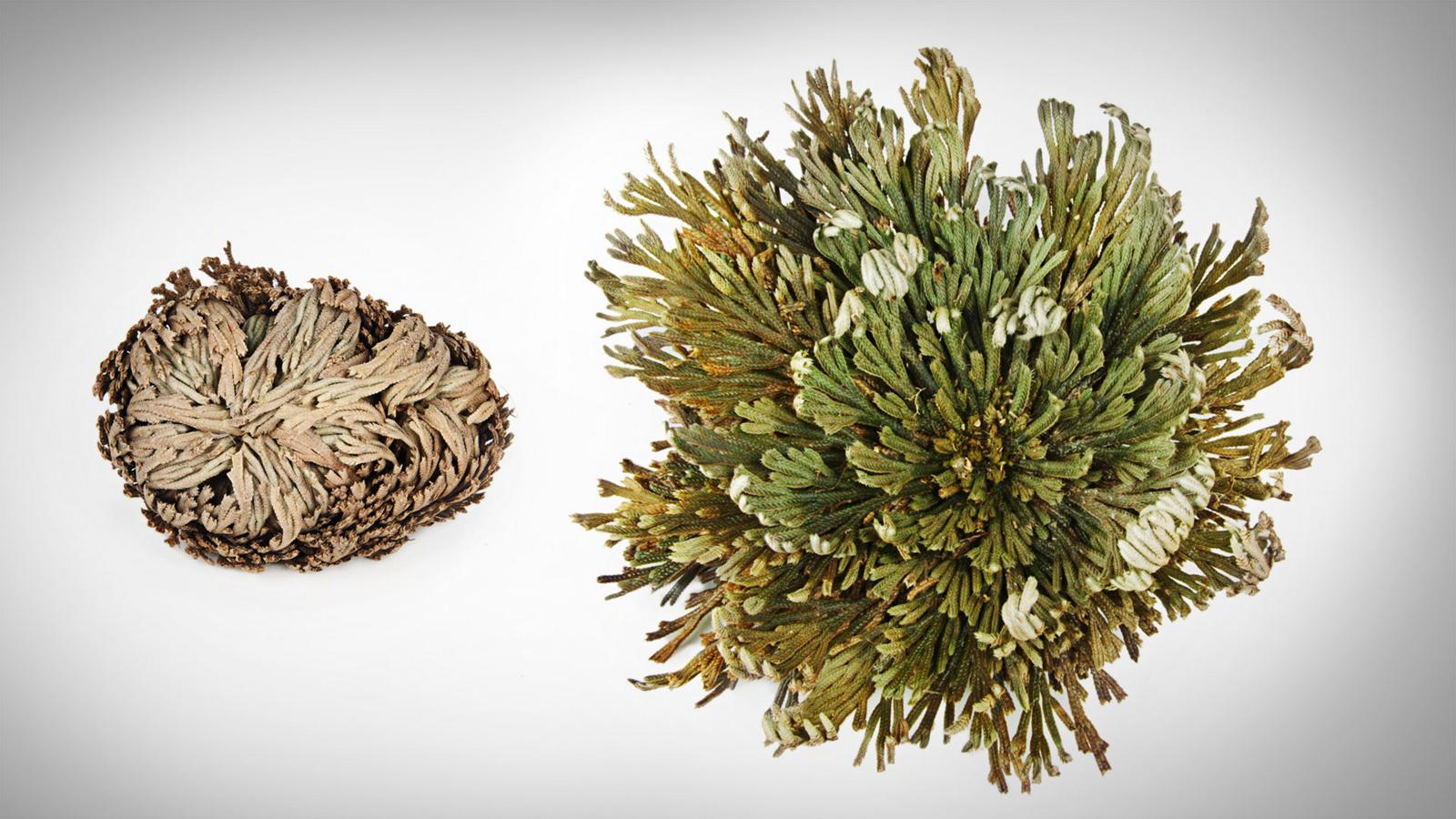
Resurrection plants future of food?

               Could ‘resurrection plants’ be the future of food?

       21 December 2015

           BBC
When she was a child, Jill Farrant, a molecular physiologist based at the University of Cape Town, came across an unusual plant. It seemed dead, yet when the rain fell from the sky, it sprung back to life. Her father didn’t believe her.
What Farrant saw was a “resurrection plant”, which can survive with no water for months to years. Seeing how quickly the plants recover is remarkable sight (Watch a timelapse in the video above at 1:30).
Now Farrant hopes to tap these abilities to transform food production. Resurrection plants have many of the same genes in their roots and leaves as seeds, so now she is trying to work out how to switch those genes in wheat, rice and maize crops so that they can survive droughts. See her explain how in the video at the top of the page.
(Credit: SPL)
Resurrection plants come back to life within 24 hours - watch the video above to see how (Credit: SPL)
The video above is part of a series called The Genius Behind: The most amazing and sometimes little known technological and scientific breakthroughs of modern times, and the innovative minds behind them.

Saturday, October 31, 2015

32,000-Year-Old Plant Brought Back to Life—Oldest Yet

http://news.nationalgeographic.com/news/2012/02/120221-oldest-seeds-regenerated-plants-science/#.Vha-QGgLUoA.facebook

Feat may help scientists preserve seeds for the future.
A plant grown from a 32,000-year-old seed.
A plant regenerated from 32,000-year-old seeds. 
The oldest plant ever to be regenerated has been grown from 32,000-year-old seeds—beating the previous recordholder by some 30,000 years. (Related: "'Methuselah' Tree Grew From 2,000-Year-Old Seed.")
A Russian team discovered a seed cache of Silene stenophylla, a flowering plant native to Siberia, that had been buried by an Ice Age squirrel near the banks of the Kolyma River (map). Radiocarbon dating confirmed that the seeds were 32,000 years old.
The mature and immature seeds, which had been entirely encased in ice, were unearthed from 124 feet (38 meters) below the permafrost, surrounded by layers that included mammoth, bison, and woolly rhinoceros bones.
The mature seeds had been damaged—perhaps by the squirrel itself, to prevent them from germinating in the burrow. But some of the immature seeds retained viable plant material.
The team extracted that tissue from the frozen seeds, placed it in vials, and successfully germinated the plants, according to a new study. The plants—identical to each other but with different flower shapes from modern S. stenophylla—grew, flowered, and, after a year, created seeds of their own.
"I can't see any intrinsic fault in the article," said botanist Peter Raven, President Emeritus of the Missouri Botanical Garden, who was not involved in the study. "Though it's such an extraordinary report that of course you'd want to repeat it."
Raven is also head of National Geographic's Committee for Research and Exploration. (The Society owns National Geographic News.)
Plant Study May Help Seed Vaults?
The new study suggests that permafrost could be a "depository for an ancient gene pool," a place where any number of now extinct species could be found and resurrected, experts say.
"Certainly some of the plants that were cultivated in ancient times and have gone extinct or other plants once important to ecosystems which have disappeared would be very useful today if they could be brought back," said Elaine Solowey, a botanist at the Arava Institute for Environmental Studiesin Israel.
Solowey resurrected the 2,000-year-old date palm that previously held the title of oldest regenerated seed.
Her palm seed, though, had been buried in a dry, cool area, a far cry from the S. stenophylla seeds' permafrost environment.
Regenerating seeds that have been frozen at 19 degrees Fahrenheit (-7 degrees Celsius) for so long could have major implications, said Solowey, who was not involved in the new study.
That's because all seed-saving projects—the most famous being perhaps Norway's so-called doomsday vault, aka the Svalbard Global Seed Vault (see pictures)—depend on freezing seeds.
"Any insight gained on seeds which have been frozen and how to thaw them and sprout them is very valuable," she said.
The Missouri Botanical Garden's Raven added that, if we can uncover the conditions that kept the seeds viable for 32,000 years, then "if you were doing it yourself, you'd be able to preserve [seeds] for longer."
Regenerated-seed study published this week in the Proceedings of the National Academy of Sciences.

Wednesday, July 22, 2015

Can the Fern That Cooled the Planet Do It Again? [c/o Scientific American]

Scientific American


Researchers hope to use the fernlike Azolla to reverse the global warming effects of burning fossil fuels
Azolla


Azolla in petri dishes. 
Credit: IRRI Images via Wikimedia Commons
Fifty-five million years ago, when scientists believe the Earth was in a near-runaway state, dangerously overheated by greenhouse gases, the Arctic Ocean was also a very different place. It was a large lake, connected to the greater oceans by one primary opening: the Turgay Sea.
When this channel closed or was blocked nearly 50 million years ago, the enclosed body of water became the perfect habitat for a small-leaved fern called Azolla. Imagine the Arctic like the Dead Sea of today: It was a hot lake that had become stratified, suffering from a lack of exchange with outside waters. That meant its waters were loaded with excess nutrients.
Azolla took advantage of the abundant nitrogen and carbon dioxide, two of its favorite foods, and flourished. Large populations formed thick mats that covered the body of the lake. When rainfall increased from the changing climate, flooding provided a thin layer of fresh water for Azolla to creep outward, over parts of the surrounding continents.
Azolla bloomed and died like this in cycles for roughly 1 million years, each time laying down an additional layer of the thick blanket of sediment that was finally found in 2004 by the Arctic Coring Expedition.
The fact that the fern only needs a little over an inch of water under it to grow makes the whole scenario seem just within reason—that is, until you learn how much carbon this carbon dioxide-hungry plant sucked up over the course of those million years.
"Around half of the CO2 available at the time," said Jonathan Bujak, who studies dust and fine plant particles as a palynologist. "Levels dropped from between 2500 and 3500 [parts per million] to between 1500 and 1600 ppm."*
While what ended the Azolla age remains unclear, the next 49 million years saw the Earth fall into a cycle that brought even more drastic drops in CO2 levels.
The southern continents broke up, and, as South America and India migrated north, the Antarctic become isolated and increasingly cold, absorbing more CO2 and creating a conveyor-belt-like effect of cold air that perpetuated ice. A succession of ice ages was triggered once the atmosphere's CO2 dropped below 600 ppm around 2.6 million years ago, just 200 ppm shy of the Earth's current estimate.
Cyclical glacial ages began, rotating between 100,000 years of massive glaciers, followed by 10,000-year breaks. By the mid-18th century, CO2 levels were at 280 ppm.
Finding modern uses for a heroic plant
"What's really incomprehensible," Bujak said, "is that the previous process of our planet cooling and CO2 dropping took 50 million years to unfold. Now, we may be reversing this process in a matter of centuries."
What is known about Azolla's true inner workings may still only skim the surface, but people all over the world, like Kathleen Pryer, a Duke professor who is crowdfunding the fern's genome, have continued to find creative ways to explore its possibilities. Alan Marshall, a former radiologist living in Tasmania, Australia, is just one example of a citizen scientist who believes Azolla can help the planet reach a better balance.
After a two-year stint as a volunteer medical radiographer in East Africa, Marshall had begun to see that advances in technology are not always best brought about at great expense. He began to search out ways to employ what he refers to as alternative, appropriate technology.
"'Alternative' means instead of industrial, expensive technology that can only be available where you have maintenance staff, you employ simpler, locally available means to do the same job," Marshall said. "'Appropriate' takes into account what the local people will accept in terms of their needs, traditional and religious views, technical prowess, etc."
Marshall had been searching for a method to treat his home's graywater, water from the sink or tub, so it could be used on his gardens, when he came across Azolla.
"Visiting a neighbor's garden, I noticed a pinkish weed growing on the surface of her pond, took a sample back home and researched it on the Internet," Marshall said. "Determining it was a species of Azolla, and that it could remove phosphates and nitrogen from water, I felt it might help."
He began experimenting with Azolla as part of a filter system and blogging about his project with other Azolla and alternative technology enthusiasts. Marshall has now come up with a three-part filter system that is effective at removing the smell from the graywater, but not at removing pathogens and viruses.
He said the development of these types of small-scale, easy-to-run mechanisms is ideal as alternative technology but could also be scaled up for use in larger systems. This is why professionals are really needed in the field to step in and guide further work, he said.
Eat your Azolla. It's good for you
Others have taken to experimenting with the edible aspect of Azolla, including Andrew Bujak, a chef and son of Jonathan Bujak. Andrew Bujak has been growing it at his home in Canada. Initially interested in the slow food concept, an Italian movement spawned in opposition to the growing influence of fast-food chains like McDonald's Corp., Bujak saw a personal use for Azolla.
"I realized this was not only a good food source, being nutritious and virtually tasteless, but it could be grown by anyone pretty much anywhere in the world. It's easy enough to find, either online or at stores selling aquariums. Just add water, literally," Bujak said with a laugh. When asked to describe the taste of the fern, Bujak compared it to a blade of grass.
Azolla has grown not only in Canada but nearly everywhere in the world, Bujak said, so it's adapted to many different regions and climates naturally. This makes it easy for people to simply pick it up and put it to use.
"Maybe you're a small-time farmer in Alberta and you want to cut costs and leave less of a carbon footprint," Bujak said. "Grow Azolla, and boom, you now have a valuable fertilizer, food source for livestock and something to eat yourself."
He added that Azolla could also be a superfood of the future, both because of its nutrition and because of how little land it requires.
Bujak said his next project is to recreate nori, pressed dried seaweed sheets, using the fern. Currently, Azolla can be sold as a nutraceutical in Canada, in capsules and powder claiming antioxidant and general health benefits, but it has yet to be approved in the United States. Bujak suggested it likely won't be long before Azolla is approved across the border, given the fern's track record.
"This plant is so incredible at every level," he said. "I wouldn't be surprised by just about anything we found out it was capable of."
China becomes fern-happy
Two weeks ago, the Beijing Genomics Institute, or BGI, owner of the most sophisticated sequencing platforms in the world, agreed to take on Pryer's project to fund the mapping of the Azolla genome. In as little as a year, the mysteries of the fern's past and full applications for the future could become open-access data.
Gane Ka-Shu Wong, one of the founders of BGI, who also teaches at Canada's University of Alberta, said the group's unorthodox origins in some ways match Pryer's scheme. While working on the human genome project in the late 1990s, Wong felt the process of science had become too institutionalized.
"The reward system in the typical government or university lab is far too focused on the individual, not the team," Wong said. Binding together with other scientists who felt similarly, Wong looked for a place to open their doors.
"We decided if we wanted to change this culture, we had to go to a place where we had virtually no competition at the time," Wong said. "In the 1990s, one place was very, very different than it is today—that place is China."
Knowing the human genome was about to be cracked, the team quickly set up shop overseas. To the great shock of their peers, they managed to complete their 1 percent contribution to the project in time.
"We had now proven we could do it, so we scaled up quickly. The government got interested, private companies got interested, and suddenly we were massive," Wong said.
Now supplying hospital tests and supplies in addition to offering a full range of other biological services, the company soon began to turn a profit.
"We began to use money from commercial projects to fund what we call 'fun science,'" Wong said, referring to projects that appeal to scientists only because they answer a question, not necessarily serving an economic function.
"The bottom line is we're a bunch of scientists who love doing science and want to make a living. So far, it's been pretty successful," Wong said. "Our aim is to get this information out there so as many people as possible can access it."
BGI will also focus on unraveling the complex relationship between Azolla and the cyanobacteria that are its close traveling companion, something BGI also sees as key to the fern's future uses and expansion of its study.
Others who have been working with Azolla for decades are thrilled at the news.
A fortune ahead for a weed?
"This knowledge will give us control over Azolla in a way we didn't have before," said Francisco Carrapico at the University of Lisbon. "We can increase carbon sequestering and nitrogen fixation, or give Azolla's properties to other plants. We've even found chemicals in Azolla that stop cell division. The question is almost what will we find that Azolla cannot do."
The fern does have one drawback, which has gained it a nasty reputation in parts of Europe and a designation as a weed in North America. Azolla, like most algae, can form massive blooms, as it did 49 million years ago in the Arctic, choking out life below.
Yet even in these cases, Jonathan Bujak argued, "the bloom is a symptom," usually due to high levels of nitrogen.
While Pryer said her motivations to pursue Azolla were mostly academic, she certainly sees the potential for venture capitalism to grow up around Azolla in the future.
"We wanted a genome for the people, by the people," Pryer said with a chuckle. Yet others think something beyond academic learning, environmental applications or industrial uses is to be gained from Pryer's work.
"Azolla has made me realize things in life are very different than what we are taught they are," Carrapico said. "Life is like the Internet: Everything is invisibly connected, but we forget this so often. We don't see how we impact one another. We can look to these connections and, through biology, invest in changes that will improve the world we leave behind."
Funding efforts for further research end Wednesday, but this certainly won't be the final chapter in the Azolla saga, a tale that began long before humans inhabited the planet and, likely, will continue long after we're gone.

*Correction (7/16/14): ClimateWire edited this sentence after posting to correct erroneous carbon dioxide levels given in the original version.
 
Reprinted from Climatewire with permission from Environment & Energy Publishing, LLC. www.eenews.net, 202-628-6500

Tuesday, June 23, 2015

Herbal meth?

THE SOVIET MILITARY SECRET THAT COULD BECOME ALASKA'S MOST VALUABLE CROP

[Copied direclty from http://www.atlasobscura.com/articles/the-soviet-military-secret-that-could-become-alaska-s-most-valuable-crop, please cite the original article at that site]

BY SARAH LASKOW / 12 MAY 2015 / SOVIET, ALASKA, RHODIOLA


Rhodiola rosea. (Photo: Botanischer Garten TU Darmstat/Flickr)

Al Poindexter’s front yard in the south-central plain of Alaska has been taken over by a spread of more than 2,000 cell trays, each growing dozens of plants that look “like something you’d expect from Mars,” he says. The little ones look like little nubs; the larger ones are no more than an inch tall and feature a spiral of fleshy leaves.

“I tried killing it—you can’t kill it. That’s my kind of plant,” says Poindexter. “It can go weeks without water. Moose don’t eat it, rabbits don’t eat it, weather doesn’t seem to bother it. It’s a real easy plant to grow.”

This is Rhodiola rosea—golden root, rose root—a succulent that was used for centuries as folk medicine and once considered something of a Soviet military secret. Decades ago, the Soviets realized that Rhodiola could boost energy and help manage stress. These days, a small group of Alaskan farmers are hoping that it could enter the pantheon of plants (coffee, chocolate, coca) whose powers people take seriously—and, along the way, become Alaska’s most valuable crop.


In Alaska, farmers spend a lot of time trying to coax plants that would prefer to be growing elsewhere into surviving in Alaska’s tough conditions. Rhodiola, though, comes from Siberia’s Altai Mountains, and it seems right at home in the frigid ground.


“It’s actually an environment that the plant wants to grow in, as opposed to everything else we grow in Alaska,” says Stephen Brown, a professor and district agriculture agent at the University of Alaska-Fairbanks. “It’ll grow in the Arctic and sub-Arctic. It wants our long days. It’s already coming up out of the ground—and the ground’s still frozen."


Rhodiola growing in a test plot in Alaska (Photo: Stephen Brown)

In the northerly parts of the world, reports of rhodiola use go back centuries—long before Carl Linnaeus first named the plant in the 18th century. It was thought to boost strength and endurance, as well as help with altitude sickness. One analogy, Stephen Brown says, it that, if caffeine makes a person’s engine run faster, “Rhodiola gives you a bigger gas tank.”

For decades, Soviet researchers worked on divining the source and strength of the plant’s power. It’s not entirely clear when their investigations began: a significant portion, Rhodiola enthusiasts say, was never published but kept close in Russia government files. In 1961, one ecologist led an expedition to the Altai mountains to search for the source of the root, and by mid-decade, serious study into the plants’ effects had started, a group of researchers reported in the journal HerbalGram in 2002.

“It was considered a Soviet military secret,” says Dr. Petra Illig, the founder of Alaska Rhodiola Products, a cooperative of Rhodiola farmers. “Most of what was done back then was unpublished and hidden in drawers in Moscow. They used it for the physical and mental performance of their soldiers and athletes.” She and other investigators have confirmed that cosmonauts in the country's space program have also experimented with Rhodiola.

One of the first vocal advocates for Rhodiola in the United States was Dr. Zakir Ramazanov, a professor of plant biochemistry and co-author of the HerbalGram article. He first encountered it during his service in the Soviet-Afghan war—not through any official source, but a fellow soldier whose family sent him Rhodiola to make into energy-boosting tea. When he came to United States in the 1990s, he started importing the plant and would travel back to the former Soviet Union to try to collect the associated studies. He was able to trace the history of Soviet research back to the 1940s, Science News reported in 2007.


Rhodiola growing in Norway (Photo: Randi Hausken/Flickr)

Dr. Illig, who’s “a standard show-me-an-x-ray-and-blood-test doctor,” as she puts it, first found out about Rhodiola from that Science News article. She had recently moved up to Alaska, and “had more time on my hands than money,” she says. She started looking into it, figuring that since Rhodiola grew in the Siberian mountains that it would also grow in Alaskan mountains. By 2010, she had given over her yard to Rhodiola seedlings—100,000 of them. She applied to the state for a grant to expand the operation, which is how Stephen Brown got pulled into the project.

“We get a lot of these application where someone is proposing these herbal medicines,” he says. “I would refer to them as ‘unicorn and rainbow’ applications”—filled with promises of cure-alls. Rhodiola, though, was different: it was backed by credible citations and peer-reviewed literature. Brown wasn’t convinced the plant actually had beneficial properties, but thought if there was a market for Rhodiola, it might be worth growing, regardless.

Now, though, he’s a convert. “I'm a marathon runner and I'm trying to do marathon in every state,” he says. “Normally, I hit the wall at mile 19.” But, then he decided to try Rhodiola. “I never had that sense of total exhaustion I normally get. That’s when I realized that there’s something to this.”


(Photo: Tero Laakso/Flickr)

Among Rhodiola boosters, personal conversion stories like this one abound—though they’re quick to say that of course there needs to be more peer-reviewed research of the highest quality, including double-blind studies. The studies that have been published, however, do show that Rhodiola has extended the life of “flies, worms and yeast.” And it's been reported that sales are growing in American health food markets, and even faster in U.S. mainstream markets, where it’s been newly introduced.

What matters for Alaskan farmers is that, compared to crops like potatoes, Rhodiola has the potential to be sold at a much higher price per acre. “The big thing we’re trying to do right now is to expand the acreage,” says Brown. There are about five acres, in total, under cultivation right now. “At 200 acres, it would be the most valuable crop in the state.”